Scientific Journal Articles
Lamb, RW, A Pérez-Matus, V Garmendia, J Suarez-Moncada, MT Ortega, S Banks, NT Sanchez, A Dubey, and JD Witman. 2025. Discovery of populations of the critically endangered coral Rhizopsammia wellingtoni in the Galápagos mesophotic zone. Conservation Science and Practice, e70103.
https://doi.org/10.1111/csp2.70103
Summary
Introduction
Rhizopsammia wellingtoni, commonly known as Wellington’s solitary coral, is a stony coral endemic to the Galápagos Islands. Once abundant in shallow waters, the species experienced a catastrophic decline following the severe 1982–1983 El Niño event, which caused widespread coral mortality due to anomalously warm ocean temperatures. Having not been officially documented since 2000, the species was classified as Critically Endangered (Possibly Extinct) by the IUCN. This study aimed to investigate whether the species had found a “refuge in depth” within the mesophotic zone—deeper, cooler reef habitats that remain buffered from the extreme thermal stress seen at the surface.
Methods
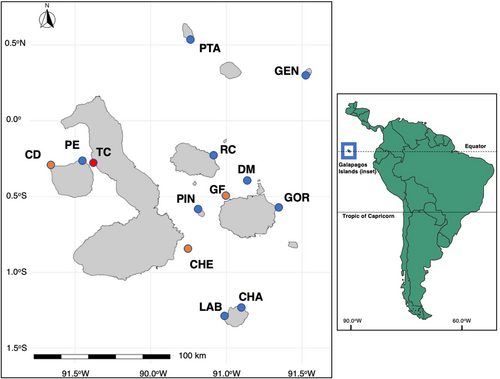
In early 2024, an international team of researchers conducted surveys across 12 sites in the Galápagos archipelago. The methodology combined technical diving using rebreathers to reach depths of 50–60 meters with Remotely Operated Vehicle (ROV) surveys extending even deeper. The team performed systematic video transects at 10-meter intervals from the surface down to the mesophotic zone. They also conducted directed searches at historical sites like Tagus Cove on Isabela Island and previously unexplored locations like Cabo Douglas on Fernandina Island. In addition to visual counts, researchers collected small tissue samples for genetic analysis to determine the connectivity and resilience of these newfound populations.
Results
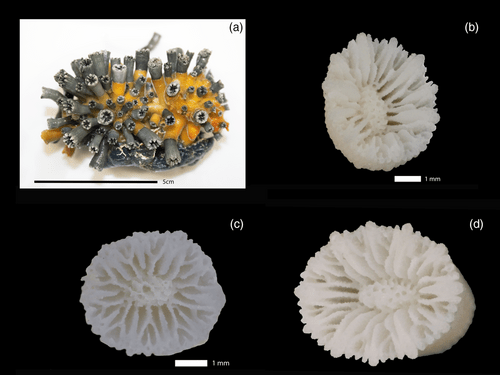
The surveys led to the rediscovery of over 250 colonies of R. wellingtoni across four main locations. While the species remained absent from the shallow transects (above 50 m) at most sites, abundant populations were discovered thriving at depths of 50–60 meters, where temperatures remained below 17°C. At Guy Fawkes, coral densities reached as high as 64.9 corals per square meter. The researchers documented two distinct color morphs—black-purple and red-black—and observed many colonies with budding polyps, a clear sign of active reproduction. Interestingly, while most populations were found in the deep mesophotic zone, a few colonies were also spotted as shallow as 12–15 meters during cooler La Niña conditions.
Discussion
The findings support the hypothesis that the mesophotic zone serves as a critical thermal refuge, allowing highly sensitive species like R. wellingtoni to persist despite the intensification of climate change and frequent El Niño events. The presence of young, solitary individuals at some sites suggests high recruitment and the potential for these deep-water “seed” populations to repopulate shallower reefs when conditions are favorable. The authors conclude that R. wellingtoni acts as a climate change sentinel, and its rediscovery emphasizes the vital importance of protecting deep-water habitats. Proactive management and continued monitoring of the Galápagos mesophotic zone are essential for the long-term survival of this and other vulnerable endemic species.
Agarwal, M, RW Lamb, F Smith, and JD Witman. 2024. Distribution and ecology of shallow-water black corals across a depth gradient on Galápagos rocky reefs. Coral Reefs, 1-13.
https://doi.org/10.1007/s00338-024-02497-6
Summary
Introduction
Antipathes galapagensis is a key habitat-forming black coral in the Galápagos Marine Reserve (GMR), yet little was previously known about its specific depth distribution and population structure. While most black corals are deep-water species, this study focused on the uniquely shallow populations found in the central Galápagos. The researchers aimed to define the upper depth limits of these corals, quantify their density and colony size across environmental gradients, and investigate how they utilize habitats. Understanding these patterns is critical for managing these CITES-regulated foundation species, which are highly sensitive to environmental disturbances and historical overharvesting.
Methods
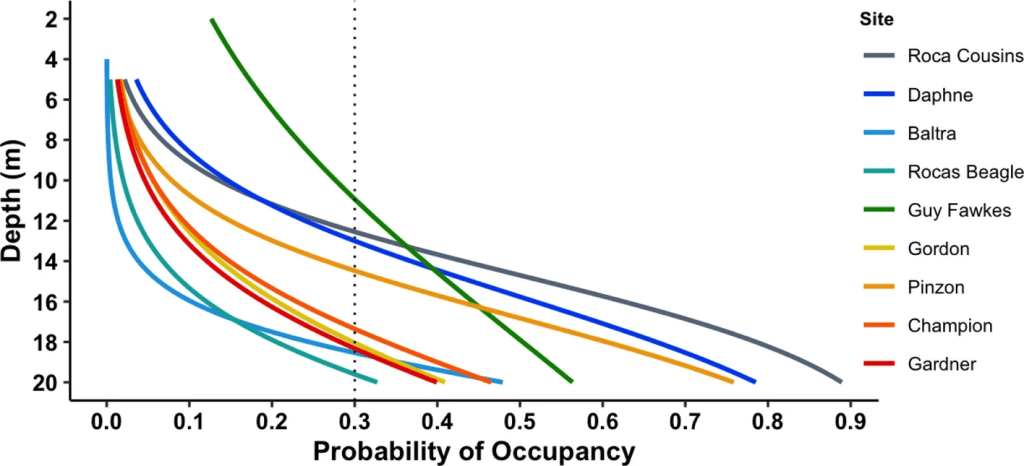
The study was conducted between 2.0 and 20.0 meters depth across nine sites in the central Galápagos Archipelago in 2021 and 2022. Researchers utilized SCUBA diving to perform two types of surveys: band transects (5.0 m x 1.0 m) at specific intervals (5, 10, 15, and 20 m) to measure colony density and height, and occupancy modeling using small quadrats to predict the probability of coral presence. Additionally, the team recorded habitat utilization (cryptic vs. exposed), estimated the percentage of epibiont overgrowth, and identified commensal functional groups. Environmental data was supplemented with CTD casts to characterize vertical water temperature gradients at the study sites.
Results
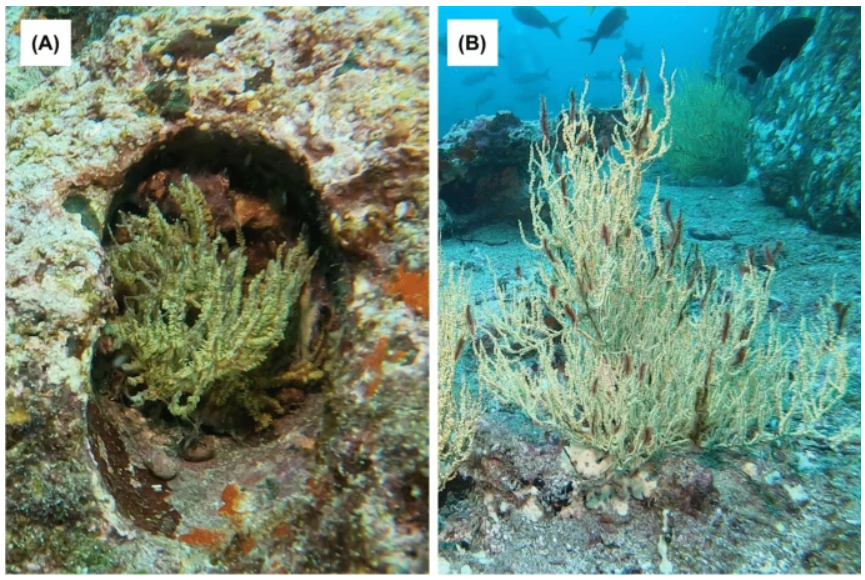
The researchers documented some of the shallowest black coral occurrences in the world, with the upper limit found at just 3.4 meters depth. Results showed that coral density and colony height increased significantly and non-linearly with depth, with maximum densities reaching 5.2 colonies per m². Interestingly, habitat utilization shifted along the gradient: corals at shallower depths (5–10 m) were predominantly cryptic, tucked into crevices or urchin bore holes, while those at deeper levels (15–20 m) were more likely to be found on exposed rock surfaces. While epibiont overgrowth (such as sponges and algae) was present at all sites, the degree of overgrowth generally did not vary significantly with depth.
Discussion
The findings suggest that the shallow distribution of A. galapagensis is likely limited by a combination of physical and biological factors rather than temperature alone. The authors propose five hypotheses for the scarcity of corals in very shallow water, including hydrodynamic forces (drag), high light levels (as larvae may be photonegative), and predation or grazing on exposed surfaces. The shift from cryptic to exposed habitats with increasing depth supports the idea that crevices provide a necessary refuge from wave surge and surge-related abrasion. Ultimately, these shallow-water “forests” act as vital foundation species, and their characterization provides a baseline for monitoring how climate change might impact vertical zonation in the Galápagos.
Castello y Tickell, S, N Low, RW Lamb, M Brandt, and JD Witman. 2022. Distribution and feeding ecology of sea stars in the Galapagos rocky subtidal zone. Journal of Experimental Marine Biology and Ecology, 553: 151754.
Preston, DL and RW Lamb. 2021. Effects of trout aquaculture on water chemistry of tropical montane streams in Ecuador. River Research and Applications: 1– 5.
Fernández-Cisternas, I, J Majlis, MI Ávila-Thieme, RW Lamb, and A Pérez-Matus. 2021. Endemic species dominate reef fish interaction networks on two isolated oceanic islands. Coral Reefs: 1-15.
Tuttle, L, RW Lamb, and A Springer. Differential learning by native versus invasive predators to avoid distasteful cleaning mutualists. 2021. Functional Ecology, 35: 1481-1490.
Lang, AE, A Yakhkind, RW Lamb, and KM Stack. Effect of a Basic Training Nicotine-Free Policy on Soldiers in the United States Army. 2021. Chest, 160: 1137-1139.
Lamb, RW, F Smith, and JD Witman. 2020. Consumer mobility predicts impacts of herbivory across an environmental stress gradient. Ecology: e02910.
Beltram, FL, RW Lamb, F Smith, and JD Witman. 2019. Rapid proliferation and impacts of cyanobacterial mats on Galapagos rocky reefs during the 2014–2017 El Niño Southern Oscillation. Journal of Experimental Marine Biology and Ecology, 514: 18-26.
Lamb, RW, AW Aued, F Smith, P Salinas de Leon, J Suarez, M Gomez-Chiarri, R Smolowitz, C Giray, and JD Witman. 2018. El Niño drives a widespread ulcerative skin disease outbreak in Galapagos marine fishes. Scientific Reports, 8:16602.
Quimbayo, JP, MS Dias, M Kulbicki, TC Mendes, RW Lamb, AF Johnson, O Aburto-Oropeza, JJ Alvarado, AA Bocos, CE Ferreira, E Garcia, OJ Luiz, I Mascareñas-Osorio, HT Pinhiero, E Salas, FA Zapata, and SR Floeter. 2018. Determinants of reef fish assemblages in tropical oceanic islands. Ecography. https://doi.org/10.1111/ecog.03506
Witman, JD and RW Lamb. 2018. Persistent differences between coastal and offshore kelp forest communities in a warming Gulf of Maine. PLOS One. https://doi.org/10.1371/journal.pone.0189388
Winkler, NS, MP Goicoechea, RW Lamb, and A Perez-Matus. 2017. Diet reveals links between morphology and foraging in a cryptic temperate reef fish. Ecology and Evolution
https://doi.org/10.1002/ece3.3604
Perez-Matus, A, F Sánchez, JC González-But, and RW Lamb. 2016. Understory algae associations and predation risk influence broad-scale kelp habitat use in a temperate reef fish. Marine Ecology Progress Series, 559: 147–158.
Witman, JD, RW Lamb, and JEK Byrnes. 2015. Towards an integration of scale and complexity in marine ecology. Ecological Monographs, 85(4): 475-504.
Lamb, RW and DW Johnson. 2010. Trophic restructuring of coral reef fish communities in a large marine reserve. Marine Ecology Progress Series, 408: 169-180.
Conference Proceedings
Lamb RW. Effects of ocean warming on fish community composition and species-specific dietary shifts. Oral Presentation – Western Society of Naturalists, Portland, OR November 2024
Lamb RW. Fish Ecology in a Rapidly Changing World. Invited Seminar – Whitney Laboratory for Marine Bioscience, St. Augustine, FL March 2024.
Lamb RW. Ecología de peces de Galápagos: retos y oportunidades para la investigación y conservación. Invited Public Seminar – Consejo de Gobierno de Santa Cruz, Puerto Ayora, Ecuador February 2024.
Lamb RW, S Thorrold, A Perez-Matus, C Munson, M Zeff, F Smith, and JD Witman. Effects of ocean warming on fish community composition and species-specific dietary shifts. Oral Presentation – Indopacific Fish Conference, Auckland, NZ November 2023.
Lamb RW. Population dynamics and feeding ecology of Galapagos reef fishes. Invited Research Seminar – University of Central Florida, Orlando, FL October 2023.
Lamb RW, JD Witman, and S Thorrold. Fish Ecology in a Rapidly Changing World. Oral Presentation – University of Florida SFFGS Invited Seminar, Gainseville, FL. September 2023.
Lamb RW, S Thorrold, A Perez-Matus, C Munson, M Zeff, F Smith, and JD Witman. A multi-species test of the temperature constraint hypothesis across a regional upwelling gradient. Oral Presentation – Benthic Ecology Meeting, Miami, FL April 2023.
Lamb RW, JD Witman, and S Thorrold. Population dynamics and feeding ecology of Galapagos reef fishes. Oral Presentation – University of Florida Nature Coast Biological Station Seminar, Cedar Key, FL. October 2022.